Train stations sell tickets for Spring Festival travel
Nhà ga xe lửa bán vé cho du lịch lễ hội mùa xuân
2011-01-11 03:37:03 GMT2011-01-11 11:37:03 (Beijing Time) China Daily

Passengers buy train tickets at a ticket office of Nanjing Railway Station, in Nanjing, capital of east China's Jiangsu province, January 10, 2010. The station began to sell the first batch of train tickets for the Spring Festival travel period on the day. The National Development and Reform Commission has predicted the nation's railway network will carry 210 million passengers during the Spring Festival travel period, which lasts from January 30 to March 10. [Photo/Xinhua]
Hành khách mua vé tàu tại một văn phòng bán vé của ga Nam Kinh, Nam Kinh, thủ phủ củatỉnh Giang Tô phía đông Trung Quốc, ngày 10 tháng 1 năm 2010. Trạm đã bắt đầu bán lô hàng đầu tiên vé tàu cho thời gian mùa xuân du lịch lễ hội vào ngày. Phát triển quốc gia vàỦy ban Cải cách đã dự đoán mạng lưới đường sắt quốc gia sẽ thực hiện 210 triệu hànhkhách trong thời gian mùa xuân du lịch lễ hội, kéo dài từ 30 Tháng Một - 10 tháng 3. [Photo / Xinhua

Passengers line up to buy train tickets at ticket offices of Nanjing Railway Station, in Nanjing, capital of east China's Jiangsu province, January 10, 2010. The station began to sell the first batch of train tickets for the Spring Festival travel period on the day. The National Development and Reform Commission has predicted the nation's railway network will carry 210 million passengers during the Spring Festival travel period, which lasts from January 30 to March 10. [Photo/Xinhua]
Hành khách đường để mua vé tàu tại các phòng vé của ga Nam Kinh, Nam Kinh, thủ phủ của tỉnh Giang Tô phía đông Trung Quốc, January 10, 2010. Trạm đã bắt đầu bán lô hàng đầu tiên vé tàu cho thời gian mùa xuân du lịch lễ hội vào ngày. Phát triển quốc gia và Ủy ban Cải cách đã dự đoán mạng lưới đường sắt quốc gia sẽ thực hiện 210 triệu hànhkhách trong thời gian mùa xuân du lịch lễ hội, kéo dài từ 30 Tháng Một - 10 tháng 3. [Photo / Xinhua

Passengers line up to buy train tickets at a ticket office of Nanjing Railway Station, in Nanjing, capital of east China's Jiangsu province, January 10, 2010. The Chinese characters on the red banner reads:"Harshly crack down on the criminal activities of ticket scalping." The station began to sell the first batch of train tickets for the Spring Festival travel period on the day. The National Development and Reform Commission has predicted the nation's railway network will carry 210 million pass
Hành khách xếp hàng mua vé tàu tại một văn phòng bán vé của trạm đường sắt Nam Kinh,Nam Kinh, thủ phủ của tỉnh Giang Tô phía đông Trung Quốc, ngày 10 tháng một năm 2010.Các nhân vật Trung Quốc vào các biểu ngữ màu đỏ lần đọc: "nghiêm khắc trừng trị thẳng tay các hoạt động tội phạm của scalping vé." Trạm đã bắt đầu bán lô hàng đầu tiên vé tàucho thời gian mùa xuân du lịch lễ hội vào ngày. Phát triển quốc gia và Ủy ban Cải cách đã dự đoán mạng lưới đường sắt quốc gia sẽ thực hiện 210 triệu vượt qua
Passengers line up to buy train tickets at the ticket hall of Hangzhou Railway Station, in Hangzhou, capital of east China's Zhejiang province, January 8, 2010. The National Development and Reform Commission has predicted the nation's railway network will carry 210 million passengers during the Spring Festival travel period, which lasts from January 30 to March 10. [Photo/sina.com.cn]
Hành khách xếp hàng mua vé tàu tại các phòng vé của Hàng Châu đường sắt Station, tại Hàng Châu, thủ phủ của tỉnh Chiết Giang, phía đông Trung Quốc, 08 Tháng Một 2010. Phát triển quốc gia và Ủy ban Cải cách đã dự đoán mạng lưới đường sắt quốc gia sẽ thực hiện210 triệu hành khách trong thời gian mùa xuân du lịch lễ hội, kéo dài từ 30 Tháng Một - 10 tháng 3. [Photo / sina.com.cn]

A student falls asleep at the ticket hall of Hangzhou Railway Station, in Hangzhou, capital of east China's Zhejiang province, January 8, 2010. The station began to sell students tickets for the Spring Festival travel period on the day. The National Development and Reform Commission has predicted the nation's railway network will carry 210 million passengers during the Spring Festival travel period, which lasts from January 30th to March 10. [Photo/sina.com.cn]
Một học sinh rơi vào giấc ngủ tại phòng vé của Hàng Châu ga, tại Hàng Châu, thủ phủ củatỉnh Chiết Giang, phía đông Trung Quốc, 08 Tháng Một 2010. Trạm đã bắt đầu bán vé sinh viên cho giai đoạn mùa xuân du lịch lễ hội vào ngày. Phát triển quốc gia và Ủy ban Cải cáchđã dự đoán mạng lưới đường sắt quốc gia sẽ thực hiện 210 triệu hành khách trong thời gian mùa xuân du lịch lễ hội, kéo dài từ 30 tháng một - 10 Tháng 3. [Photo / sina.com.cn]
The station began to sell the first batch of train tickets for the Spring Festival travel period on the day. The National Development and Reform Commission has predicted the nation's railway network will carry 210 million passengers during the Spring Festival travel period, which lasts from January 30 to March 10.
Trạm đã bắt đầu bán lô hàng đầu tiên vé tàu cho thời gian mùa xuân du lịch lễ hội vào ngày.Phát triển quốc gia và Ủy ban Cải cách đã dự đoán mạng lưới đường sắt quốc gia sẽ thực hiện 210 triệu hành khách trong thời gian mùa xuân du lịch lễ hội, kéo dài từ 30 Tháng Một - 10 tháng 3.
______________________________________________________________________
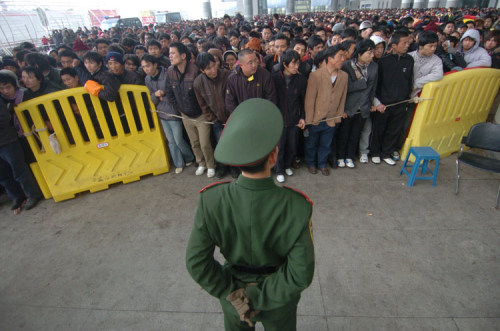
春运, “chun yun”, is the term for the many Chinese people who travel around the Spring Festival (Chinese New Year) time period. Many Chinese people who have left their hometowns to work in other places in China must “return home” to visit their families and celebrate the holiday together. This happens every year and most people travel by taking the train. Train tickets can only be sold and purchased a maximum of 10 days before the desired departure date and there are only a limited amount of tickets available. This is one reason why many people must line up and wait many long hours (or days) so they can buy a train ticket to go home for Spring Festival, which is Janauary 25 this year. Here are some pictures of the lines and people waiting to buy train tickets in Ningbo:
春运, "chun yun", là một thuật ngữ cho người Trung Quốc rất nhiều người đi du lịch xung quanh các lễ hội mùa xuân (năm mới của Trung Quốc) khoảng thời gian. Nhiều người Trung Quốc người đã rời quê hương để làm việc ở những nơi khác ở Trung Quốc phải "trở về nhà" để thăm gia đình của họ và cùng nhau ăn mừng ngày lễ. Điều này xảy ra mỗi nămvà hầu hết mọi người đi du lịch bằng cách đi tàu. Vé tàu chỉ có thể được bán và mua tối đa là 10 ngày trước ngày khởi hành mong muốn và chỉ có một số lượng hạn chế vé có sẵn.Đây là một trong những lý do tại sao nhiều người phải xếp hàng và chờ đợi nhiều giờ đồng hồ dài (hoặc ngày) để họ có thể mua một vé xe lửa để về nhà cho Lễ hội mùa xuân, đó làJanauary 25 năm nay. Dưới đây là một số hình ảnh của dòng người chờ đợi để mua vé tàutại Ningbo:
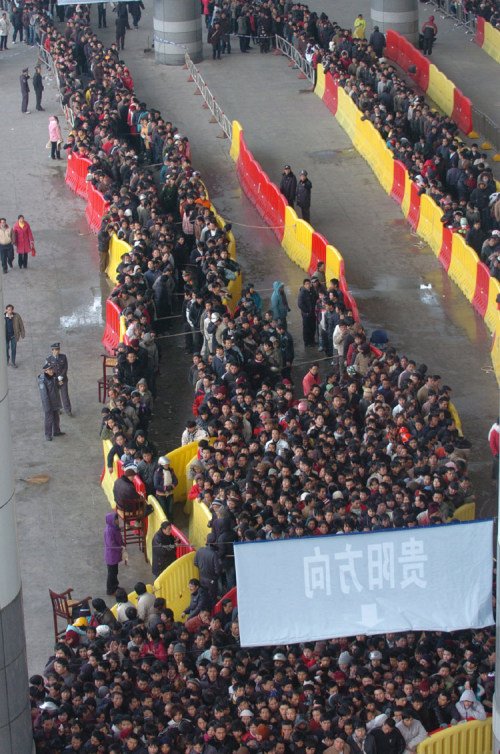
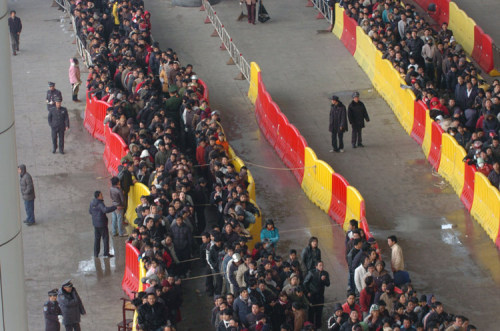
A large and crammed contingent of people buying tickets to go home.
Một đội ngũ lớn và chen chúc của những người mua vé để về nhà.
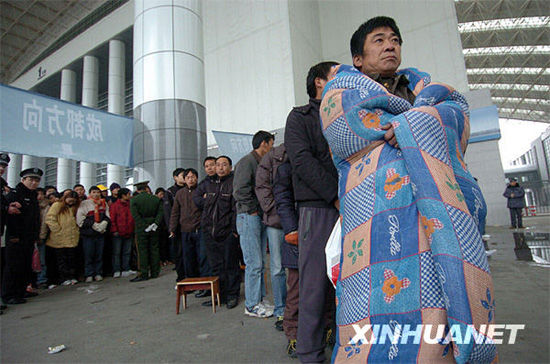
January 2, at the Ningbo International Exhibition Center temporary ticket sales location, a ticket-buyer who has queued for two days drapes a cotton blanket around him waiting to buy tickets.
02 Tháng 1, tại Trung tâm Triển lãm Quốc tế Ningbo vị trí tạm thời doanh thu bán vé, người mua vé đã xếp hàng đợi cho hai ngày màn cửa một tấm chăn bông xung quanh anh ta chờ đợi để mua vé.
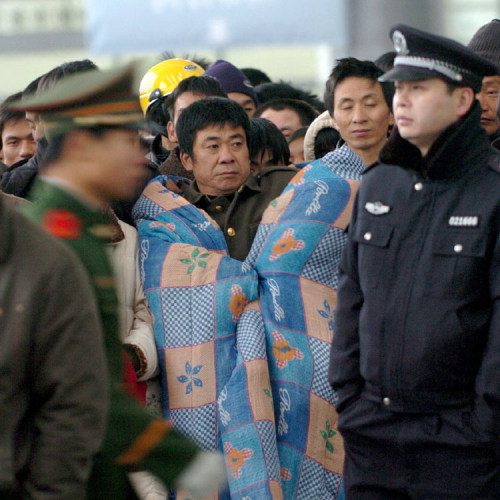
"Buying ticket with blanket" is a powerful complaint/denouncement against the area government's inaction or bad actions.
"Mua vé với chăn" là một đơn khiếu nại / tố cáo mạnh mẽ chống lại không hành động hoặc hành động xấu của chính phủ khu vực.
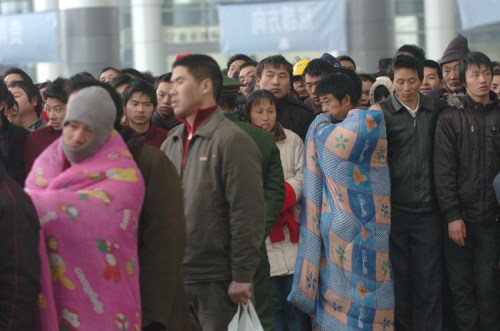
The road home is endlessly long, when can the "difficulty of buying tickets" finally get a fundamental solution?
Các nhà đường dài vô tận, khi có thể khó khăn trong việc mua vé "cuối cùng đã có được một giải pháp cơ bản?
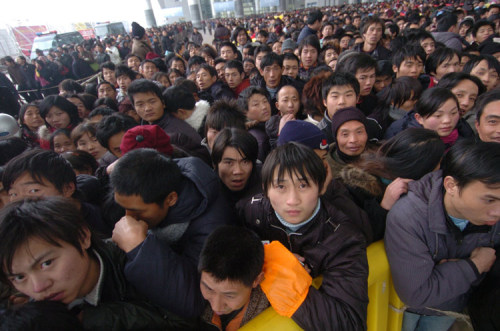
Pairs and pairs of eyes longing to go home, but the awkward result after waiting could be "tickets have been sold out."
Cặp và cặp mắt khao khát về nhà, nhưng kết quả khó xử sau khi chờ đợi có thể là "vé đãđược bán ra ngoài."
These pictures are from Xian, China - Những hình ảnh từ Tây An, Trung Quốc:
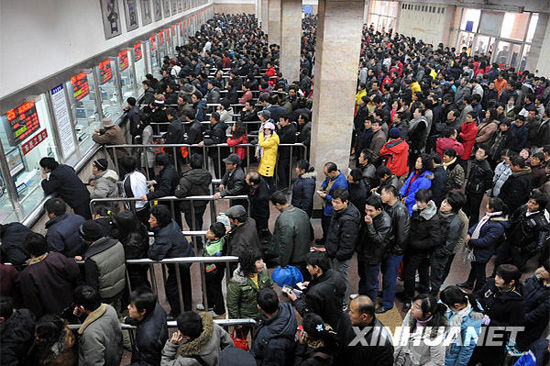
2011 January 3, at Xian Railway Station, people queue to purchase train tickets.
2011 ngày 03 Tháng 1, tại ga Tây An, người dân xếp hàng để mua vé tàu.
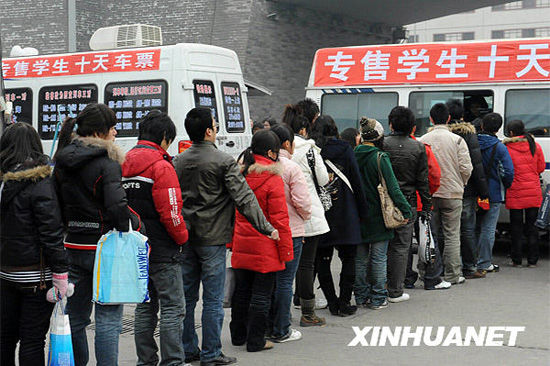
2011 January 3, at Xian Railway Station's mobile ticket selling point, many students line up to buy train tickets.
2011 03 Tháng Một, vào thời điểm điện thoại di động Xian ga bán vé, nhiều học sinh xếp hàng để mua vé tàu.
Comments from ý kiến từ NetEase:
In many places in Guangdong, there are a lot of people who cannot get tickets, but ticket scalpers have many tickets. After getting arrested, a ticket scalper immediately says he has connections to get out. He also says there are so many people doing it, so he is not afraid
Ở nhiều nơi ở Quảng Đông, có rất nhiều những người không có thể nhận được vé, nhưngscalpers vé có vé. Sau khi bị bắt giữ, một người giải phẩu bằng dao nhỏ vé ngay lập tứcnói rằng ông đã kết nối để nhận ra. Ông cũng nói rằng có rất nhiều người làm việc đó, vì vậy anh không sợ.
Chúc tất cả mọi người có thể nhận được vé và trở về nhà vào thời gian để chào mừng nămmới! Là vé của tôi ở đâu? ...Wish everyone can all get tickets and return home on time to celebrate the new year! Where is my ticket? …
Làm thế nào đến chúng ta không thấy bất kỳ dấu hiệu của các cán bộ lãnh đạo?How come we do not see any sign of the leading cadres???
Với Chun Yun nên nhiều năm nay, nó vẫn là giống nhau, ngay cả với các xu hướng ngày càng tăng. Tôi muốn hỏi bộ phận quản lý của nước này có liên quan thực hiện, làm thế nàođăng ký hộ gia đình đang quản lý, làm thế nào kiểm soát sinh đẻ đang được kiểm soát là gì,và liệu pháp luật hôn nhân và pháp luật quy định tuổi kết hôn là một trong số ít ngày!With Chun Yun so many years now, it is still the same, even with increasing trends. I want to ask just what are the country’s relevant management departments doing, how are household registrations being managed, how is birth control being controlled, and whether marriage laws and legal marriage age regulations are a little out of date!!!
Tên của người mua vé nên được in trên vé tàu hoặc mã số tài liệu có đủ điều kiện!The name of the person who purchased the ticket should be printed on the train ticket or qualified identification document numbers!
Nó thực sự là nghiêm trọng ngay bây giờ, có phải chờ đợi lâu dài của một dòng chỉ để muamột tấm vé để về nhà.It is really severe right now, having to wait this long of a line just to buy a ticket to go home.
Kỳ nghỉ Mỗi như thế này, dẫn đến nhiều người ăn mừng năm mới, các ngày lễ từ nhà,không thể được đoàn tụ với gia đình của họ. Có thể thay đổi tình huống này?Every holiday is like this, leading to many people celebrating the new year, the holidays away from home, unable to be reunited with their families. Is it possible to change this kind of situation?
Thần của tôi thở dài, người mà chúng ta có thể đổ lỗi? Ai làm cho chúng tôi có rất nhiềungười?Sigh, my god, who can we blame? Who made us have so much people?!
I really really want to go home. I am afraid of not being able to get a ticket. It has been three years now that I have not gone home. Seeing what you all have said is really frightening, just like there not being anymore train tickets tomorrow.
There is not even a decent queue, so how could it be anything but messy?!
The Ministry of Railways, the group of pigs, is too stupid! Yelling for so many years and still nothing can be done! Pigs!!! (Also possibly wolves! Otherwise, what would this group of wolves eat?)
Sigh, the miserable journey is about to begin again!!!
Comments from Sina:
It has been many years since I have been home to celebrate Spring Festival.
There is no way [for me to get home]…
Fellow workers: Everyone work together, and do not go buy those expensive tickets [from ticket scalpers]. After ten days, what can those ticket scalpers do…
The people inside and outside of the train stations are in collusion, giving the majority of tickets to the ticket touts and dividing the profits between themselves. So for places like Dongguan Railway Station where for several days straight there were no tickets available immediately upon opening the [ticket sales] windows, where did those tickets go???
In this respect, China is really awful, often not having any tickets even before tickets begin being sold. The Railway Bureau’s management is really awful.
Seeing these scenes every year makes my head hurt, faint, and want to vomit. Yet every year I must experience this kind of scene twice. Sigh!!!
This definitely is not China… [sarcasm]
From Youku Buzz:
In this video uploaded yesterday by a Youku user, you can see the long queue outside the railway station in Hefei, Anhui. Most passengers in this first wave of “chunyun” were college students who had waited hours at the temporary ticket windows.
Brutal weather takes rising toll in China
 |
www.chinaview.cn  2008-01-29 08:52:41 2008-01-29 08:52:41 |   Print Print |
BEIJING, Jan. 29 -- Unremitting harsh weather across large parts of the nation has pushed up the human and economic toll as traffic snarls continued ahead of the major holiday. Snowfall, the worst in five decades in many places, has affected 77.86 million people in 14 provinces in northern, central, eastern and southern China by 2 pm yesterday, the Ministry of Civil Affairs said.
At least 24 people were killed in accidents over two weeks due to snow, sleet and freezing cold, it said, adding that direct economic losses have totaled 22.09 billion yuan ($3.06 billion). The extreme weather has forced the evacuation of 827,000 people to safer places, damaged 4.22 million hectares of crops, toppled 107,000 houses and damaged 399,000 homes. In hardest-hit Hunan, 29.15 million people have been affected, including 10 who died. The direct economic loss has exceeded 10.7 billion yuan ($1.48 billion), accounting for nearly half of the country's total. Many highways, railways and airports were paralyzed, especially in the east. The bad weather since Jan 12 has disrupted travel plans of tens of millions heading home to celebrate the Lunar New Year, starting on Feb 7 this year. |


China pledges crackdown on ticket scalping
The Ministry of Public Security (MPS) vowed to tighten security checks and strengthen crackdowns on train ticket scalpers to ensure the safety of hundreds of millions of travelers during the upcoming Spring Festival.
![Many students rush a train ticket sales agent in an attempt to buy a ticket home for the winter break in Nanjing city, capital of East China's Jiangsu province on Dec 28, 2011, the day the rail authority started selling student tickets for the Spring Festival travel period.[Photo/CFP]](https://lh3.googleusercontent.com/blogger_img_proxy/AEn0k_sihK_-4ZaMldzZIJn2ULMsk8WLVPk867w9enp6CUftYut0BigSUMlv45Em64PasQh7d6iekt8w6k_pAkaA53GnplSzPLtqaSxtL9l8EPdVQX34Qivos82l8aOfBlKSVFcfkav4GY0jRcFJ_gAiSoOGNOJ1sLrK=s0-d "Many students rush a train ticket sales agent in an attempt to buy a ticket home for the winter break in Nanjing city, capital of East China's Jiangsu province on Dec 28, 2011, the day the rail authority started selling student tickets for the Spring Festival travel period.[Photo/CFP]") |
Many students rush a train ticket sales agent in an attempt to buy a ticket home for the winter break in Nanjing city, capital of East China's Jiangsu province on Dec 28, 2011, the day the rail authority started selling student tickets for the Spring Festival travel period.[Photo/CFP]
|
Local police have been urged to maintain the order of various stations, especially those adopting the real-name ticket selling system, and increase the scrutiny of inflammable cargo, according to a statement released Wednesday by the ministry.
The supply of railway tickets during travel peaks often fails to meet demand, and scalpers take advantage of this by hoarding tickets through various means and reselling them at much higher prices.
To alleviate the situation, China's railway system will carry out an online ticket-booking system and a real-name ticket purchasing system for this year's travel rush, which requires passengers to provide their ID numbers when buying tickets during the peak travel season.
The MPS statement urged police nationwide to focus on illegal deeds, such as forging fake documents and train tickets, and ordered them to be ready to handle crimes and emergencies, especially around stations.
The Spring Festival, which falls on Jan. 22 this year, is the most important traditional Chinese festival for family reunions.
It is estimated that a record 235 million trips will be made by railway nationwide during this year's peak period from Jan. 8 to Feb. 16.


Something big happened on Jan 8th. It is the start of the largest scaled as well as periodical migration in human history – the Chinese spring transport (春运), which was, is and always will be the dominating theme of Chinese media for the next 40 days.
It is predicted that during the 40-day long transport season, there will be over 3.15 billion passenger flow, breaking another historical record set by 2011 with 2.85 billion(sina). To help you get a better picture of the situation, according to Netease, it is like the whole population of China moves twice.
China's Spring Festival madness begins

In soso baike, the reasons why people are starting to travel all at the same period of every year are briefly categorized into 3 aspects:
1. Uneven development of the economy – the east and south part of China is much more developed than the rest of the country, which results in the huge population of migrant workers.
2. The transportation system is inadequate, which fails to handle passengers eruption properly – Chinese railway network is the 3rd largest in the world in terms of miles, but break it down, it is only 5.8 cm per capita (2006).
3. There is not enough long-period holiday. Except for the National Day golden week, Spring Festival is the only holiday lasts longer than a week. And Spring Festival happens to be the biggest festival for Chinese people. Everyone wants to go home.
Oh, and this year, there is another reason adding to list as covered in our previous post: Internet booking.
Photos around the Internet on the spring transport.

Dec 30 2011, at Nanjing Railway Station. University student also has significant contribution to the spring transport passenger flow, since schools finish during late December and early January.

Dec 30, 2011, Wuhan Hankou railway station, a little girl is kissing her father while waiting in line for the tickets.
 Dec 29,2011, Anhui Hefei railway station.
Dec 29, 2011, at Hunan Changsha railway station.

Jan 1, 2012, Zhaoxing Station. The total railway traffic on the opening day of 2012 hit 5.096 million people (Netease).

Jan 1, 2012, Xi’an Station.

Jan 1, 2012, Zhejiang Province, Zhoushan City.

To attract more patients, a hospital in Fuzhou City advertised on its screen board that says “come to see our doctors and we will give you train tickets.”

Jan 8, 2012, the official kick-off day of the largest migration in human history. a woman is carrying her luggage.

Jan 8, 2012, a migrant worker in Shanghai is proudly holding his ticket home.

Jan 8, 2012, a man was in argument with the police when his too-eager wish of getting a ticket home was unmet.

Getting a ticket is a difficult home going story, surviving the journey is another.


Nonetheless, all these struggles and torments are bearable and worthwhile, because what awaits them at the end of the trip is home, sweet home.
Millions Scramble To Get Home
Revelers struggle to secure travel tickets during the biggest holiday migration of the year in China.
 AFP
AFP
Passengers line up at the Guangzhou Railway Station during the Lunar New Year travel rush, Jan. 8, 2012.

AFPPassengers line up at the Guangzhou Railway Station during the Lunar New Year travel rush, Jan. 8, 2012.
Overloaded telephone and online ticketing services have done little to make the job of buying a rail or bus ticket home for millions of Chinese any easier ahead of the Lunar New Year holiday later this month.
The desperate scramble for the hard-to-get tickets kicked off on Sunday, as China's railways released the first tranche of tickets and seat allocations in the largest human migration on the planet.
"There is an online ticket-buying site," said a migrant worker surnamed Song, who is trying to get a ticket from the southern economic boomtown of Shenzhen to her hometown in southwest China's Sichuan province ahead of the all-important family reunion meal on New Year's Eve.
"But it's totally useless ... I couldn't order a ticket in the end."
Faced with millions of calls to a handful of ticket sales lines, frozen websites, or all-night queuing and violent jostling at China's main urban railway stations, many people are forced to "go through the back door," compounding the problem for those without official connections.
A second worker, surnamed Zhang, said he had managed to procure his ticket home this year, but not via the official ticketing services.
"You can try the website," he said. "But it's not like there's a cast-iron guarantee."
A third worker, surnamed Zhao, said most options resulted in queuing, which in China is punctuated by yelled instructions from officials with megaphones, scuffles with would-be queue-jumpers, and a constant fear that one's efforts will come to nothing.
"You can reserve by phone or you can queue, but if you don't have time, then you have to queue anyway," she said. "Even if you call up and reserve your tickets, you still have to stand in line to collect them."
Black market sales
A worker surnamed Chen trying to return to her hometown in Hunan province said on Monday that the authorities had instituted a real-name registration system for ticket sales this year, in an attempt to clamp down on a nationwide, and well-connected, black market in train and bus tickets.
But she said the result had been fewer options for beleaguered travelers, with fewer touts selling black-market tickets at inflated prices.
"You can't get tickets, you can't order tickets," she said. "Everyone says you can't get them online, either."
But she said some lines, including the one running inland from Guangdong towards Wuhan, had seen some easing of pressure since the high-speed rail links began.
"At least on those lines, it might take a bit longer, but you'll be able to get a ticket," Zhao said. "But on the lines where there's no bullet train you can stand in line but you still won't get a ticket."
She added: "Online, there are so many people trying to buy tickets that you can't even get into the website."
Officials admitted last week that the railway ministry's ticketing website crashed under the sheer volume of page requests, leaving many people with money taken from their credit cards, but no tickets.
The ministry issued more than six million tickets last Monday alone, official media reported, with 1.6 million of those bought over the phone.
The ministry expects Chinese travelers to make more than three billion trips in the lunar New Year period, which will usher in the Year of the Dragon.
Reported by Xin Yu for RFA's Mandarin service and by Lin Jing for the Cantonese service. Translated and written in English by Luisetta Mudie.
The desperate scramble for the hard-to-get tickets kicked off on Sunday, as China's railways released the first tranche of tickets and seat allocations in the largest human migration on the planet.
"There is an online ticket-buying site," said a migrant worker surnamed Song, who is trying to get a ticket from the southern economic boomtown of Shenzhen to her hometown in southwest China's Sichuan province ahead of the all-important family reunion meal on New Year's Eve.
"But it's totally useless ... I couldn't order a ticket in the end."
Faced with millions of calls to a handful of ticket sales lines, frozen websites, or all-night queuing and violent jostling at China's main urban railway stations, many people are forced to "go through the back door," compounding the problem for those without official connections.
A second worker, surnamed Zhang, said he had managed to procure his ticket home this year, but not via the official ticketing services.
"You can try the website," he said. "But it's not like there's a cast-iron guarantee."
A third worker, surnamed Zhao, said most options resulted in queuing, which in China is punctuated by yelled instructions from officials with megaphones, scuffles with would-be queue-jumpers, and a constant fear that one's efforts will come to nothing.
"You can reserve by phone or you can queue, but if you don't have time, then you have to queue anyway," she said. "Even if you call up and reserve your tickets, you still have to stand in line to collect them."
Black market sales
A worker surnamed Chen trying to return to her hometown in Hunan province said on Monday that the authorities had instituted a real-name registration system for ticket sales this year, in an attempt to clamp down on a nationwide, and well-connected, black market in train and bus tickets.
But she said the result had been fewer options for beleaguered travelers, with fewer touts selling black-market tickets at inflated prices.
"You can't get tickets, you can't order tickets," she said. "Everyone says you can't get them online, either."
But she said some lines, including the one running inland from Guangdong towards Wuhan, had seen some easing of pressure since the high-speed rail links began.
"At least on those lines, it might take a bit longer, but you'll be able to get a ticket," Zhao said. "But on the lines where there's no bullet train you can stand in line but you still won't get a ticket."
She added: "Online, there are so many people trying to buy tickets that you can't even get into the website."
Officials admitted last week that the railway ministry's ticketing website crashed under the sheer volume of page requests, leaving many people with money taken from their credit cards, but no tickets.
The ministry issued more than six million tickets last Monday alone, official media reported, with 1.6 million of those bought over the phone.
The ministry expects Chinese travelers to make more than three billion trips in the lunar New Year period, which will usher in the Year of the Dragon.
Reported by Xin Yu for RFA's Mandarin service and by Lin Jing for the Cantonese service. Translated and written in English by Luisetta Mudie.
China media: Annual migration
9 January 2012 Last updated at 01:07 ET

China's annual Spring Festival travel rush is believed to be the biggest migration in the world
Most Chinese newspapers lead on the start of the annual migration for the Spring Festival - also known as Chinese New Year.
Beijing's Ministry of Transport said the number of passenger trips was expected to reach 3.16bn within the 40-day period, which is yet a new record high, reports the English edition of Global Times.
Although most of these trips will be made by road, the focus still remains with the scandal-hit railway system, which the China Daily says will handle some 235 million passenger trips.
The Overseas Edition of People's Daily praised the first day of operations at Beijing West Station as being smooth, while Beijing News said the Railway Ministry had placed diesel locomotives and back-up generators across the country on stand-by.
The paper says this was a measure to prevent any extreme weather bringing the network into a standstill - something that hit the travel rush period hard back in 2008.
However, the first day of festive travel period has already seen some fatalities - an intercity coach overturned in Guizhou province, reports the Shanghai Morning Post and others, killing at least four people and injuring dozens.
While the national papers are yet to gear up on their coverage of the visit by President Lee Myung-bak of South Korea, China Daily, citing an unnamed source from the Ministry of Commerce, reports that talks on a bilateral free trade agreement (FTA) will be announced.
The source also says talks on a China-Japan-South Korea FTA are expected to start in the first half of this year.
People's Daily runs a commentary in its Overseas Edition which states that China and South Korea are yet to solve issues such as political mutual trust between the two countries.
In other news, the paper's domestic edition reports on Premier Wen Jiabao's renewed instructions over the weekend that financial institutions should work on easing lending difficulties for the actual economy, while also suppressing speculative activities.
Beijing News carries an interview by the official Xinhua News Agency with an unnamed official from the State Council's Office for Rectifying Malpractices which says some 1,400 counts of forced demolition across the country have been investigated, with around 500 people being "accounted for".
People's Daily reports separately on an order issued by the Ministry of Land and Resources that no forced demolitions should happen again.
Newspapers in Hong Kong - including The Standard and Ming Pao Daily News - focus on two stories on Monday.
The first is a online-called mass rally outside the Hong Kong flagship store of Italian luxury fashion brand Dolce & Gabbana, where locals demanded an apology for alleged discrimination that banned then from taking pictures of its show window.
The other story is the primary election being held by Hong Kong's pan-democratic camp on Sunday that picked a united candidate to run for the Chief Executive election, which will take place in March.
Albert Ho, chairman of the Democratic Party, won this first-ever primary election in Hong Kong, while a politician from the camp suggests that hackers have been attempting to attack their internet-based voting system without success.
China's annual Spring Festival travel rush is believed to be the biggest migration in the world
Most Chinese newspapers lead on the start of the annual migration for the Spring Festival - also known as Chinese New Year.
Beijing's Ministry of Transport said the number of passenger trips was expected to reach 3.16bn within the 40-day period, which is yet a new record high, reports the English edition of Global Times.
Although most of these trips will be made by road, the focus still remains with the scandal-hit railway system, which the China Daily says will handle some 235 million passenger trips.
The Overseas Edition of People's Daily praised the first day of operations at Beijing West Station as being smooth, while Beijing News said the Railway Ministry had placed diesel locomotives and back-up generators across the country on stand-by.
The paper says this was a measure to prevent any extreme weather bringing the network into a standstill - something that hit the travel rush period hard back in 2008.
However, the first day of festive travel period has already seen some fatalities - an intercity coach overturned in Guizhou province, reports the Shanghai Morning Post and others, killing at least four people and injuring dozens.
While the national papers are yet to gear up on their coverage of the visit by President Lee Myung-bak of South Korea, China Daily, citing an unnamed source from the Ministry of Commerce, reports that talks on a bilateral free trade agreement (FTA) will be announced.
The source also says talks on a China-Japan-South Korea FTA are expected to start in the first half of this year.
People's Daily runs a commentary in its Overseas Edition which states that China and South Korea are yet to solve issues such as political mutual trust between the two countries.
In other news, the paper's domestic edition reports on Premier Wen Jiabao's renewed instructions over the weekend that financial institutions should work on easing lending difficulties for the actual economy, while also suppressing speculative activities.
Beijing News carries an interview by the official Xinhua News Agency with an unnamed official from the State Council's Office for Rectifying Malpractices which says some 1,400 counts of forced demolition across the country have been investigated, with around 500 people being "accounted for".
People's Daily reports separately on an order issued by the Ministry of Land and Resources that no forced demolitions should happen again.
Newspapers in Hong Kong - including The Standard and Ming Pao Daily News - focus on two stories on Monday.
The first is a online-called mass rally outside the Hong Kong flagship store of Italian luxury fashion brand Dolce & Gabbana, where locals demanded an apology for alleged discrimination that banned then from taking pictures of its show window.
The other story is the primary election being held by Hong Kong's pan-democratic camp on Sunday that picked a united candidate to run for the Chief Executive election, which will take place in March.
Albert Ho, chairman of the Democratic Party, won this first-ever primary election in Hong Kong, while a politician from the camp suggests that hackers have been attempting to attack their internet-based voting system without success.
_________________________________________________________________________________
Travel peak during China's "Golden Week"
 |
| Huge crowds of people visit the Dr. Sun Yat-sen's Mausoleum, a burial site of Dr. Sun Yat- sen, a great democratic revolution pioneer in China, in Nanjing, capital of east China's Jiangsu Province, Oct. 2, 2011. During the week-long National Day Holiday starting from Oct. 1, the country's 119 scenic spots under monitoring list received over 24.3 million visitors, up 8.84 percent year-on-year, and the tourism revenues reached 1.25 billon yuan (196 million U.S. dollars), up 10.57 percent year-on-year. (Xinhua/Wang Xin) |
 |
| Visitors play on the beach of Bo'ao, south China's Hainan Province, Oct. 5, 2011. During the week-long National Day Holiday starting from Oct. 1, the country's 119 scenic spots under monitoring list received over 24.3 million visitors, up 8.84 percent year-on-year, and the tourism revenues reached 1.25 billon yuan (196 million U.S. dollars), up 10.57 percent year-on-year. (Xinhua/Meng Zhongde) |
 |
| People visit the cultural street in north China's Tianjin, Oct. 5, 2011. During the week- long National Day Holiday starting from Oct. 1, the country's 119 scenic spots under monitoring list received over 24.3 million visitors, up 8.84 percent year-on-year, and the tourism revenues reached 1.25 billon yuan (196 million U.S. dollars), up 10.57 percent year-on-year. (Xinhua/Liu Xiaochuan) |
 |
| Passengers try to board trains at the railway station in Jiujiang, east China's Jiangxi Province, Oct. 7, 2011. China's railways are especially busy on Friday, the last day of the week-long National Day holiday, as vacationers begin to return to their working places. (Xinhua/Hu Guolin) |
 |
| Huge crowds of people visit Tian'anmen Square in Beijing, capital of China, Oct. 4, 2011. During the week-long National Day Holiday starting from Oct. 1, the country's 119 scenic spots under monitoring list received over 24.3 million visitors, up 8.84 percent year-on- year, and the tourism revenues reached 1.25 billon yuan (196 million U.S. dollars), up 10.57 percent year-on-year. (Xinhua/Liu Debin) |
 |
| Passengers receive security check before boarding bullet trains at a railway station in Nanjing, capital of east China's Jiangsu Province, Oct. 7, 2011. China's railways are especially busy on Friday, the last day of the week-long National Day holiday, as vacationers begin to return to their working places. (Xinhua/Sun Zhongnan) |

From Tianya:
The annual Spring Festival (Chinese New Year) travel season officially began on January 30. According to the information disclosed by the Ministry of Railways 2010 Spring Festival travel season is from January 30 to March 10, about 40 days, 15 days before the New Year, and 25 days after the New Year. According to an authoritative forecast, Spring Festival travel season this year expects 2.5 billion passengers.

“Desire to go home, difficult to get a ticket”
At 3 pm on January 20, 2010, the Shanghai Railway Station already started to have presale tickets for the first day of the Spring Festival travel season January 30. Shanghai Station Norton Square opens 200 windows selling tickets at the same time.

January 20, 2010 afternoon, at the Ningbo International Convention and Exhibition Center, the temporary railway ticket booth, a migrant young man from Guangxi province named Liang Xiangui sleeps soundly on the railing of a long ticket line.

January 21, Passengers in Shenzhen North Railway Station to buy train tickets from the real-name system (a system first time used in China which requires passengers to give real name to purchase the train tickets and boarding the train with their IDs)

January 21, 2010, Mr. Liu from Fuyang bought a train ticket from the real-name system, because he used first generation ID card, the ticket shows his ID number but not his name.

January 21, at the Tianjin train station presale ticket booth, a student got her ticket to go home.

January 20, Chengdu train station, a university student is saying hello to her friend.

1/21, passengers are getting ready to board the train at Shenyang North Station.

January 24, 2010 in Shenyang, Liaoning Province, the railway station reached peak Spring Festival season early, migrant workers from Gansu with children are waiting to return home.
In 2010 Spring Festival travel season, we hope to show more care to "children going home" this somewhat helpless groups. Spring Festival travel season, please let the children to go first.
In 2010 Spring Festival travel season, we hope to show more care to "children going home" this somewhat helpless groups. Spring Festival travel season, please let the children to go first.

1/20/2009, Dongguan train station, a little traveler is boarding.

January 21, 2010, on the second of Shanghai Spring Festival train ticket pre-sale, a father with his daughter are dragging luggage and getting ready to board the train.

January 17, 2010, Shanghai South Railway Station Square, a child is playing.

January 26, 2010, Qingdao railway station where the passenger gathers, although the national Spring Festival travel season has not officially began yet, people have already stepped on the Spring Festival journey.

January 30 is the first day of Spring Festival travel season in 2010.
Staffs are checking passengers’ documents and tickets. On the first day of Spring Festival travel season, Guangzhou train with the pilot real-name system does not appear to have expected long lines. Operation of the railway station is stable and smooth.
Staffs are checking passengers’ documents and tickets. On the first day of Spring Festival travel season, Guangzhou train with the pilot real-name system does not appear to have expected long lines. Operation of the railway station is stable and smooth.

January 30, Anhui, Hefei railway station, the passengers are boarding the train.

January 30 is the first day of Spring Festival travel season in 2010.
Zhengzhou Railway Bureau has developed several sets of the spring program in response to peak traffic periods before and after the festival.
Zhengzhou Railway Bureau has developed several sets of the spring program in response to peak traffic periods before and after the festival.

January 30 is the first day of Spring Festival in 2010.
In Urumqi West Railway Station, passengers are prepared to board the train from the Urumqi to Chengdu.
In Urumqi West Railway Station, passengers are prepared to board the train from the Urumqi to Chengdu.

January 30, passengers are waiting at the Beijing West Railway Station.

January 30, passengers at Wuchang Railway Station.

January 30 is the first day of Spring Festival travel season in 2010.
Harbin Railway Station smoothly handled over 70,000 passengers, an increase of about 2,000 people the previous day.
Harbin Railway Station smoothly handled over 70,000 passengers, an increase of about 2,000 people the previous day.

January 30 is the first day of Spring Festival travel season in 2010.
Nanjing Railway passenger traffic is surging, the station fully mobilizes all sectors into the spring transportation work. In 2010 Spring Festival period, the Nanjing Railway Station is expected to send more than 2.3 million passengers, an increase of 0.8%.
Nanjing Railway passenger traffic is surging, the station fully mobilizes all sectors into the spring transportation work. In 2010 Spring Festival period, the Nanjing Railway Station is expected to send more than 2.3 million passengers, an increase of 0.8%.

Open and in operation for at least one month, Wuhan-Guangzhou high-speed EMUs from Wuhan to Guangzhou from the will in crease its number from 23 pairs to 29 pairs, in order to ease the the Spring Festival passenger flow.

January 30, a passenger is carrying a suitcase walking in the Guangzhou Railway Station Square.

January 30, Harbin Railway Station, a little passengers look out the window.

January 30, during the Spring Festival travel season, Nanning Railway Bureau, Nanning Railway Station is expected to send more than 930,000 passengers on their trips, on average 23,000 travelers a day and 43,000 on the peak day.

January 30, the first day of Spring Festival travel season in 2010, Chengdu Railway Police Department held a "Chengdu police are around you" event, warning the travelers to be on high alert for thief and fake tickets etc. in order to promote travel safety.
Chengdu Railway Police Department SWAT Team, patrolling with dogs

January 30, Anhui, Hefei railway station, the passengers are boarding.

January 30, in Beijing Liuliqiao long-distance bus station, guide workers are distributing free napkins to the travelers.

January 30, in Beijing Liuliqiao long-distance bus station, passengers is boarding a bus to go to Zhangjiakou, Hebei.

January 30, in Beijing Liuliqiao long-distance bus station, passengers are boarding.

January 30 , the first day of Spring Festival travel season in 2010, Fuzhou Railway Station opens a total of 24 ticket windows, 10 automatic ticket vending machines, 40 ticket booth outside of the station, in addition, five new EMU ticket window and four telephone booking windows to facilitate travelers during the Spring Festival.

January 30, a little passenger at Bengbu train station looks out a windows on the train.

Bengbu railway policemen helps left-behind children in rural areas to reunite with their migrant worker parents who are unable to return home because of work. providing green path-way for left-behind children to board them as soon as possible.

January 30, Nanjing Railway Station, travelers line up at the temporary ticketing booth.

North Square of Beijing West Railway Station

January 29, Shanghai Railway Station, the train passengers are waiting to take off.

January 29, Shanghai Railway Station, a passenger is smoking on the platform. According to the prediction of relevant departments in Shanghai, the peak will occur around February 10.

Early hours of January 30, passengers at Beijing West Railway Station are ready to board. 40-day Spring Festival travel season is expected to send 210 million passengers, an increase of 18.2 million passengers, an increase of 9.5%, 5.25 million passengers daily.

January 30, the nation’s first trip to implement real-name system, #L7688 at 0:26 departs from the Guangzhou Railway Station.

January 30, passengers at the Hefei Railway Station. Hefei station Spring Festival security work starts early, by deploying additional police force to crack down on ticket scalpers, maintaining order, and to ensure a smooth traveling.

January 30, 2010, a child let by his parents is going home from the Hefei Railway Station.

Early hours of January 30, passengers are waiting in the Harbin railway station waiting room.

At 3 PM on January 20, 2010, Shanghai Railway Station North Square, 200 hypermarkets ticket window is officially open for presale tickets of EMUs train as early as 21 days, other train tickets for 11 days.
January 21, 2010, Shenzhen, people who buy ticket for others must bring ids and take care of the 100 yuan bills.

A little boy looks outside in the crowded train .

A small boy was elevated on the shoulders of their parents to avoid being injured.

A little girl is watched her father eating instant noodles, drooling.

A little kid is doing homework in the waiting room of the train station.

A mother drags her a spoiled child waling by the train.

passengers on a crowded train are squeezed into the the glass door.

January 29 afternoon, 2 PM, waiting in Guangzhou Pazhou at a off-site point of junction of Hunan Shaoyang, travelers Tang Yuan (third left) who is the first to use the real-name system for ticket validated.


January 28, before the ticket windows are open, the police came to photograph the people for records. Recently, in order to prevent ticket brokers reselling tickets in short supply, the Shanghai Railway Police put a number of measures to restrict ticket selling.


January 30, the Guangzhou train started real-name system, passengers only need to scan ID cards and tickets in the verification device, a computer will be able to show the information.

January 30, Changsha railway station, big bags and small bags

Passengers are ready to board a train from Fuzhou to Chongqing.

January 30, Beijing West Railway Station Square, a Chinese migrant worker is carrying a huge bag to return home.

January 30, a youth in the Beijing Railway Station ticket hall, looking at the ticket Bulletin Board.

January 30, Hubei Yichang Railway Station, passengers on the train are having lunch.

January 30, several passengers are sleeping in Xi’an Railway Station waiting room.

The photo shows a man calls his girlfriend and reminds her to take care of the luggage.

The photo shows the railway station in Shenyang City, Liaoning Province, passengers with luggage ready to take the train to return home, to celebrate the Year of the Tiger Chinese New Year.

January 30, Guiyang Railway Station


No comments:
Post a Comment